

How voice technology saved a resident’s life, and changed how a community runs.
“Residents often struggle with the remote control. They struggle with their cell phones. But Serenity is easy for them!”
– Christine Ferguson, Executive Director, The Inn at Garden Plaza

Overview
Senior living has spent the last two decades adding communication channels: overhead speakers, phone trees, printed calendars, pendants, portals. None of them solved the underlying problem. The resident still misses the message, and staff still spend their day chasing the gaps. The Inn at Garden Plaza, a Century Park independent living community, took a different approach.
They implemented Serenity Smart, an in-room voice-based technology that residents actually use, and automated and streamlined their workflows with it. Manual phone trees, printed flyers, and at-the-table announcements have largely given way to a single channel that reaches every apartment. Safety infrastructure the community already owned, like the pull cord system and the PA system, stays in place for now, and is now reinforced by an additional, reliable way for residents to call for help. What changed is which channel residents reach first, how consistently messages land, and how many staff hours come back to resident-facing work.
And when a resident fell in her apartment, unable to reach her phone or the pull cord, she used her voice to call for help. Staff reached her immediately. She later told everyone at town hall that the technology had saved her life.
The Problem Every Operator Knows
If you run a senior living community, your communication stack looks roughly the same as it did twenty years ago. The daily special is announced at the table. Package arrivals trigger a round of phone calls or sticky notes from the front desk. Urgent updates go out over a PA system residents can’t always understand. Emergencies depend on a pull cord that requires reaching the wall, or a pendant that often sits on the nightstand. And families stay informed either by calling in to ask, or through a generic weekly email blast, neither of which builds the relationship families expect.
Each of those channels works some of the time. The real problem is that none of them reaches residents reliably, and the staff time spent chasing the gaps is substantial. Operators have tried to close those gaps by adding tablets, apps, and resident portals. Most of those efforts stall because they ask residents to adapt to the technology. For a population that may struggle with remote controls and smartphones, that’s a bigger ask than it looks.
What Digital Transformation Actually Looks Like
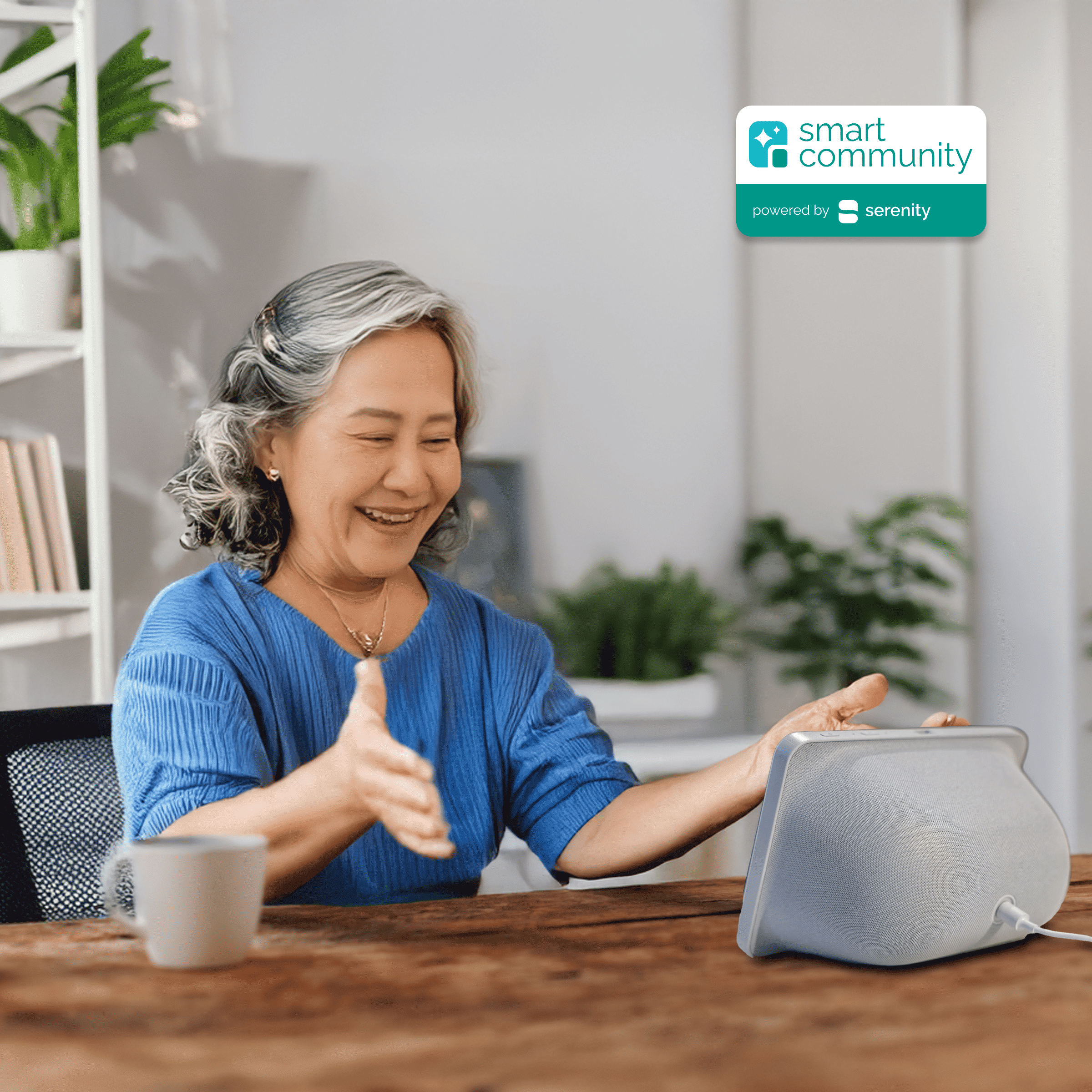
The Inn at Garden Plaza rolled out Serenity Smart across its 150 apartment independent living community. The platform puts a secure, voice-enabled Serenity smart-assistant device in every apartment and gives staff a single interface to run wellness check-ins, broadcast announcements, manage day-to-day communications, and give residents a new way to call for help. It also gives residents a way to independently access the information they used to have to ask for. The daily menu, today’s activities, the weather are all available simply by asking aloud.
The manual workflows that used to consume staff time have largely been replaced: calling every resident about a package, distributing printed flyers, repeating announcements at the table. The pull cord system and PA system stay in place. The PA is often hard for residents to hear or understand, but it remains available for now alongside Serenity’s clearer, in-apartment delivery. The workflows the team runs every day in Serenity Smart are exponentially faster and more efficient.
| Daily Workflow | Before Serenity | With Serenity |
|---|---|---|
| Wellness check-in | Button-based check-in system | Voice check-in with 15-minute reminders until 10 a.m. Sustained 92%+ monthly participation, the highest in the Century Park portfolio |
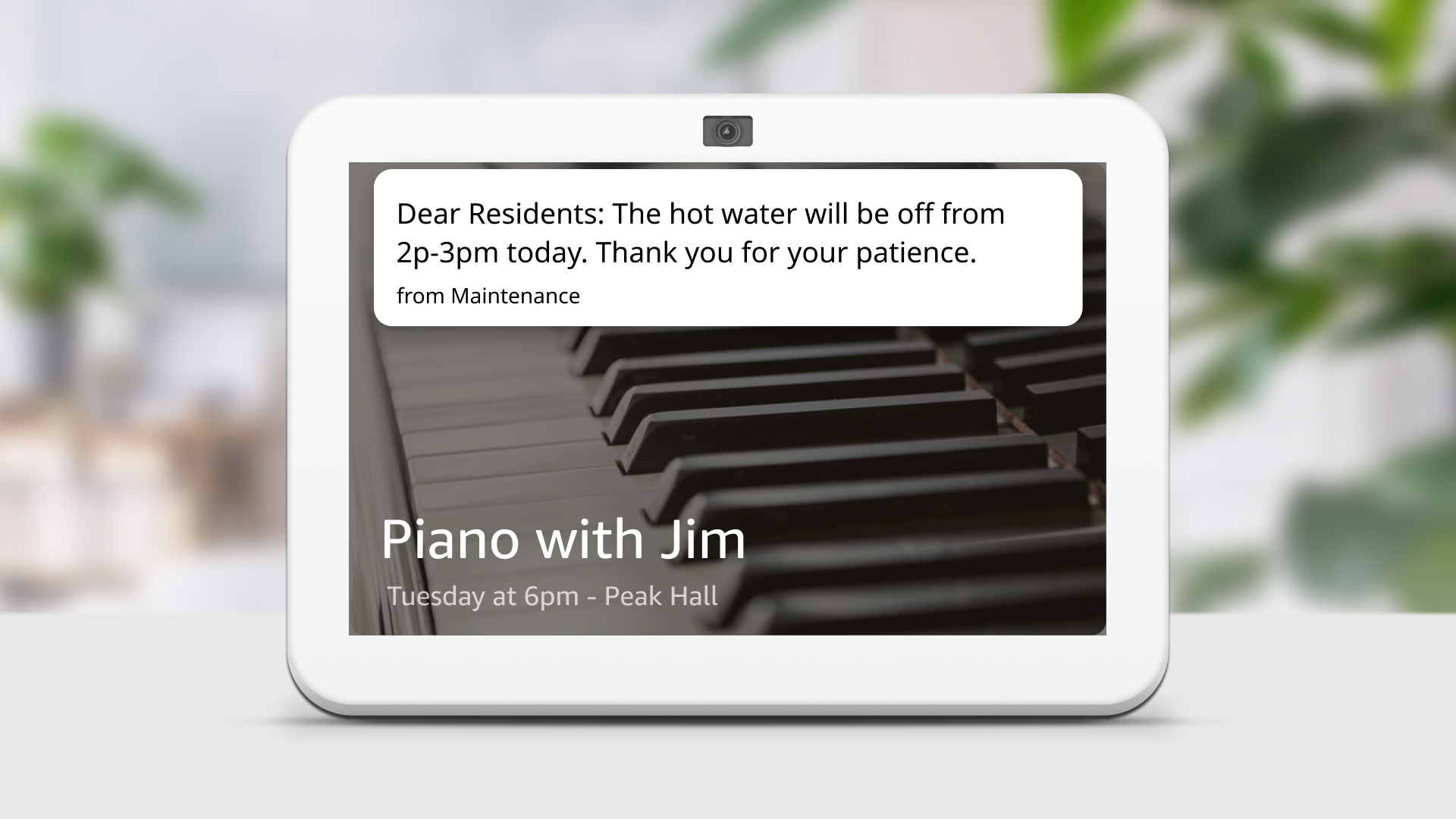
| Package notifications | Front desk calls each resident individually | One message to every apartment; residents come down on their own. Part of 500+ announcements sent per month |
| Urgent building updates | Overhead speaker (often hard to hear or understand) and paper flyers | Announcement delivered clearly to every apartment, replacing the manual scramble |
| Daily dining specials | Posted by the dining room; announced by servers at the table | Pushed to every resident before the meal, and one of the most valued daily updates |
| Activity reminders | Printed monthly calendar | Reminders throughout the day. Staff report higher turnout, supported by 92% average monthly Echo engagement |
| Calling for help | Pull cord on the wall or a wearable pendant | Voice call to the front desk as an additional option, reachable from anywhere in the unit |
The Outcomes, Measured
Inn at Garden Plaza leads every community in the Century Park portfolio on the metrics that matter for adoption and engagement:
- 99% active device rate, sustained every month since rollout, and the highest in the Century Park portfolio.
- 92%+ monthly check-in participation, notably higher than what the community saw under its previous button-based check-in system.
- ~500 announcements sent per month, peaking above 700 during high-volume periods like the holidays.
- 94% peak Echo engagement, with a sustained 92% monthly average.
- Higher activity turnout, driven by in-day reminders that the printed monthly calendar couldn’t deliver on its own.
Where the Investment Case Became Concrete
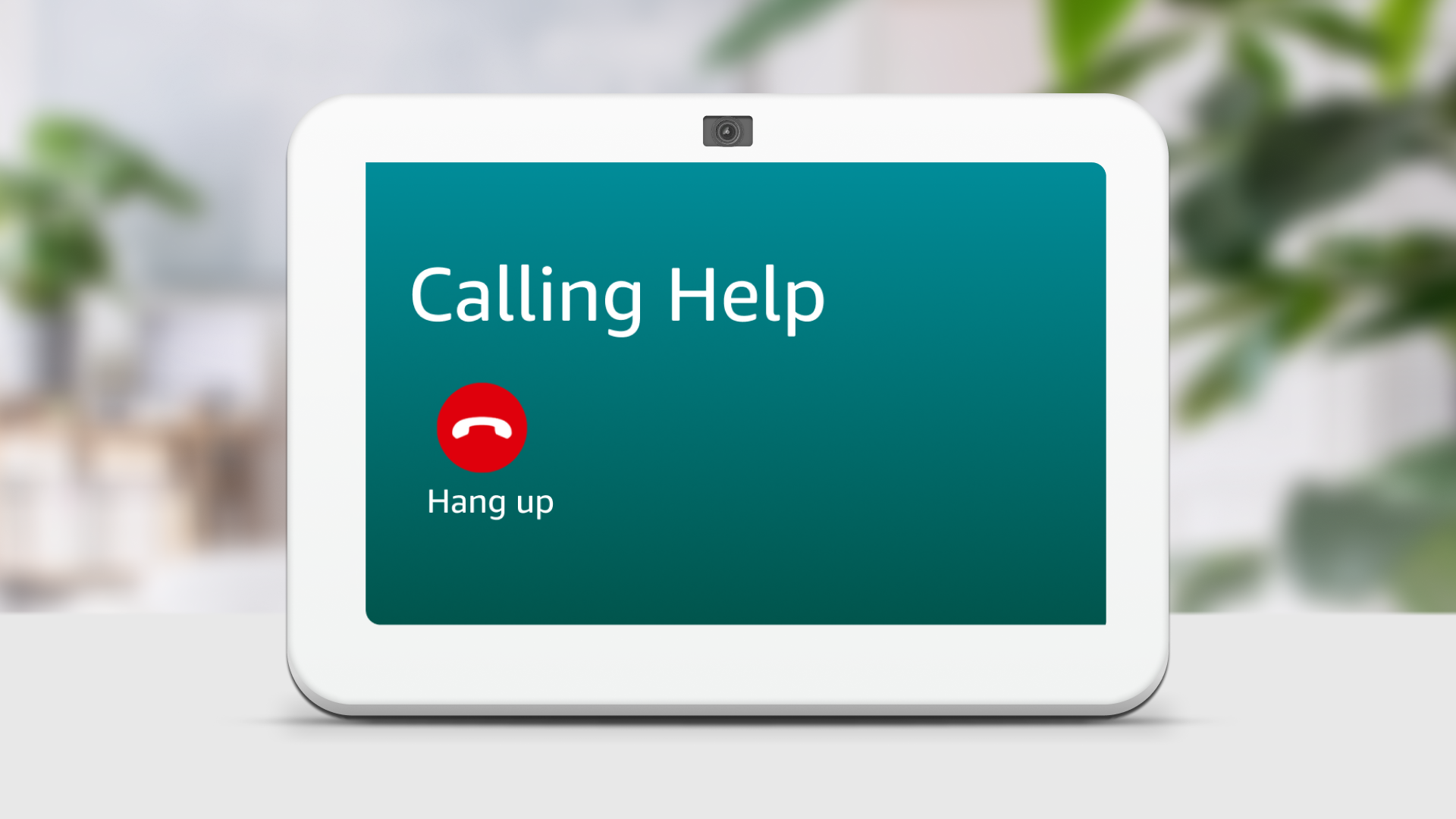
A resident fell in her apartment, away from her phone and out of reach of the pull cord. She used her Serenity smart assistant to call the front desk by voice. Staff reached her immediately and called 911. In the weeks that followed, she went out of her way, at town hall and in the hallways, to tell every resident she could find what had happened.
“Our resident wanted me to share with everybody how this saved her life.”
Christine Ferguson, Executive Director
Existing safety infrastructure only works when residents can reach it, and research consistently shows they often can’t. A 2026 industry survey found that only 18% of personal emergency response device users wear their device at all times. Peer-reviewed research published in the BMJ similarly found that call alarms were widely available but were not used in most cases of falls that led to residents lying on the floor for extended periods. Falls remain the single largest driver of emergency response and hospitalization in senior living. Adding a reachable, voice-activated option to the existing safety stack has clinical and liability implications that matter well beyond the cost of the technology.
Why It Worked: What a New Operator Should Copy
Every Serenity community gets the same product. Not every community gets these numbers. The Inn at Garden Plaza’s leadership was explicit about what made the difference, and almost none of it was technical.
1. Leadership went first, publicly.
The executive director introduced Serenity at a town hall as something exciting, not something residents would have to tolerate. Every department head showed up visibly engaged. Residents take their cues from staff energy. A hesitant rollout produces a hesitant building.
2. Staff activated devices room by room.
No mass emails, no “pick one up at the front desk,” and no sending in a vendor the residents had never met before. The same staff residents already trusted physically went to every apartment, plugged in the Serenity smart assistant, and walked the resident through weather, music, check-ins, and help calls. The entire building was activated in less than a day. The first interaction with the technology was always in-person, supported, and successful.
3. The old check-in system ran in parallel for two weeks.
Residents weren’t forced off the familiar check-in system on day one. A two-week overlap gave them practice runway. By the time the old system was turned off, the new one already felt routine.
4. Every staff member was trained, not just the front office.
Housekeepers, maintenance, concierges, and dining staff all learned Serenity. That meant a resident who couldn’t remember a command had someone to ask no matter who was in the room. Adoption compounds when the whole building can support it.
5. Serenity became part of lease signing.
The executive director keeps an Echo on her desk and demonstrates it during the contract signing. Families leave the meeting already sold on the safety story, and new residents arrive already expecting to use it. Adoption starts before move-in.
6. The most reluctant residents often became the most active users.
Every community has residents who push back on technology in the first 30 to 60 days. They’re the ones who say it’s not for them, who don’t want another device, who insist they’ll stick with the old way. The Inn at Garden Plaza’s team didn’t pressure those residents. They invested time with them: sitting in the apartment, demonstrating what the Serenity smart assistant could do beyond check-ins, finding the use case that resonated personally. Classical music. Weather in the city where the grandchildren live. A way to call for help without crossing the room.
That patience consistently paid off. Some of the loudest early skeptics are now among the community’s most engaged users, and the ones telling other residents what’s possible.
“If somebody was pushing back and saying ‘I’m not using this,’ we’d just go spend some time with them and show them something they could do that mattered to them. Like play music or video call their family. This got them engaged and the rest was easy.”
– Linda McGlothin, Lifestyles Director
The Bigger Picture for Operators
Senior living is being pressured from every direction on digital transformation. Labor costs are rising faster than rate increases, and every manual workflow is a place where those costs compound. Adult children evaluating communities for their parents are digital natives who expect communication parity with every other service in their lives. Regulators and insurers are showing increased interest in fall response and incident documentation. And the incoming resident cohort, early boomers, will not accept the operational experience their parents tolerated.
Early Movers Compound the Advantage
The operators who move early won’t just save staff time. They’ll differentiate on tours, close faster, and accumulate the kind of operational signal that makes future decisions better. The ones that wait will be competing against communities with a multi-year head start on engagement.
The Inn at Garden Plaza isn’t an outlier because of who their residents are. They’re an outlier because of what leadership chose to do. That choice is available to any operator reading this.
About The Inn at Garden Plaza
The Inn at Garden Plaza is a Century Park community in Colorado Springs, Colorado, offering 150 independent living apartments.
Questions We Hear From Operators
How do senior living communities achieve high resident adoption of voice technology?
The senior living communities with the highest voice technology adoption make it part of the resident and staff experience from day one. The Inn at Garden Plaza, a Century Park community, reached 99% device adoption with Serenity Smart by having leadership publicly champion the rollout, training every staff member to support the technology, running the previous check-in system in parallel for two weeks, and demonstrating the platform during lease signings so families and residents arrive already familiar with it.
How long does it take to roll out community-wide voice technology in senior living?
The Inn at Garden Plaza activated all 150 apartments in less than a day. Staff who residents already trusted went room by room, plugged in each Smart Concierge device, and walked residents through basic voice commands in person. The previous check-in system continued running in parallel for two weeks after activation, giving residents time to practice before the old system was retired.
Can voice-activated devices help with emergency response in senior living?
Yes. At The Inn at Garden Plaza, a resident who fell in her apartment used her Smart Concierge to call the front desk by voice when she could not reach her phone or the pull cord. Staff responded immediately and 911 was called. Voice-based help calls do not replace pull cords or pendants. They add a reachable option from anywhere in the unit, closing a gap in existing emergency infrastructure.
How does Serenity Smart reduce staff time in senior living communities?
Serenity Smart replaces the manual communication workflows that consume the most staff time each day. Instead of calling every resident individually to announce package arrivals, distributing paper flyers, or repeating specials at the table, staff send one message that reaches every apartment. The Inn at Garden Plaza sends approximately 500 announcements per month through the platform, and staff hours previously spent on manual outreach are redirected to resident-facing work.
Why do senior living residents adopt voice technology when they struggle with smartphones and remote controls?
Voice technology like Serenity Smart requires no learning curve. Residents speak naturally to ask about the weather, the daily menu, or the day’s activities, and the device responds. Unlike smartphones, tablets, or resident portals, voice devices do not require residents to adapt to new interfaces or navigate touchscreens. In Executive Director Christine Ferguson’s words: “The remote control they struggle with. Their cell phones they struggle with. But Serenity is easy.”
Does technology matter to families evaluating senior living communities?
Yes. Families evaluating senior living communities increasingly expect the communication and safety capabilities they experience in every other service in their lives. At The Inn at Garden Plaza, the executive director demonstrates Serenity Smart’s