

A white paper for hospice leaders
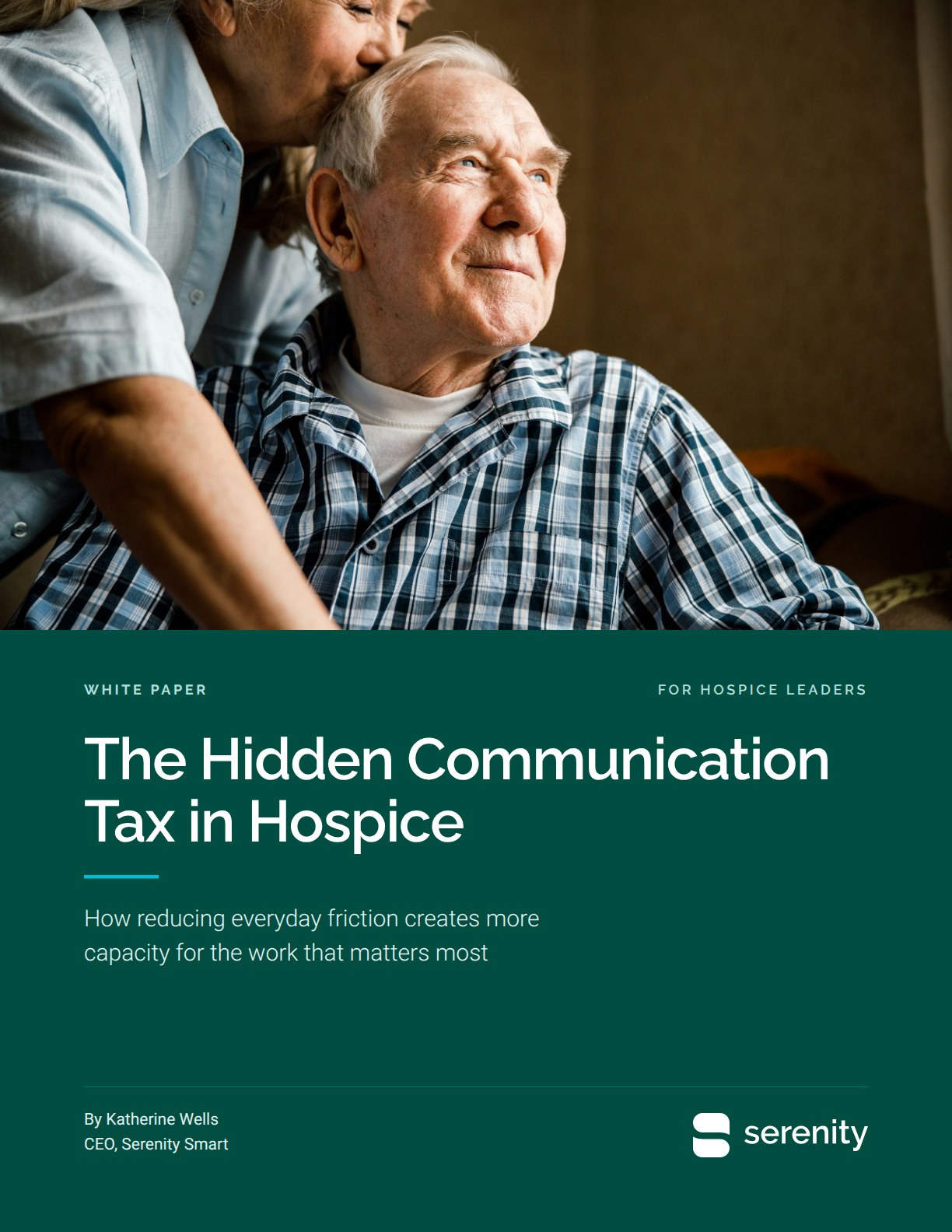
The Hidden Communication Tax in Hospice
How reducing everyday friction creates more capacity for the work that matters most
Every day, dedicated hospice teams spend hours tracking down information, repeating updates and relaying messages between people who can’t reach each other. That time never shows up on a P&L, but your organization pays for it. This paper shows you how to find it and give it back.
Read the white paper
Free to download and share with your leadership team.
Download the white paperPrefer it in your inbox? We’ll email you a copy.
Next, see where your hospice stands with the Hospice Communication Score.
Four places communication friction hides
The paper gives your team a shared language for the extra work that piles up around patient care, so you can see it, measure it and start removing it.
CHASE
Someone tracks down information that should already be at their fingertips, making three calls just to confirm one order.
REPEAT
Someone shares the same update over and over, copying and pasting it or placing five separate phone calls.
RELAY
Someone becomes the go-between. A nurse tells an aide, who tells the son, who has questions, and the message changes with each handoff.
DISCOVER LATE
Important information arrives too late to prevent a problem that could have been avoided.
What you’ll take away
A clear view of the problem
See where the communication tax shows up across census, workforce, margin, referral relationships, family experience and leadership visibility.
A way to put a number on it
Estimate the hours, and the full-time staff equivalents, your team spends on avoidable communication work each year.
A 30-minute audit
A worksheet your leadership team can use this week to trace one patient journey and find where to start.
Communication makes care visible to the people who aren’t there to see it.
Grounded in real hospice experience
MorseLife Hospice, Family Hospice Care and Dignity Hospice
The paper draws on the experiences of hospice organizations working to reduce friction, along with data from CMS Care Compare, the CAHPS Hospice Survey and the Hospice Salary & Benefits Report.
About the author
Katherine Wells is passionate about making care easier to coordinate for the people who provide it and the families who depend on it. For five years she co-hosted the Mavericks of Senior Living podcast, interviewing leaders across aging services. Today she is CEO of Serenity Smart, an integrated, HIPAA-compliant platform that connects care teams, families and partners.
Frequently asked questions
What is the communication tax in hospice?
The communication tax is the unnecessary friction that forces valuable hospice staff to spend extra time and effort making sure everyone has what they need. It shows up as repeated phone calls, duplicated updates, follow-ups and searching for context. It never appears as a line item on a P&L, so it is absorbed into payroll, interruptions and mental load.
Where does communication friction show up in a hospice?
The white paper describes four patterns. CHASE is tracking down information that should already be at someone’s fingertips. REPEAT is sharing the same update over and over with different people. RELAY is one person acting as the go-between, with the message changing at each handoff. DISCOVER LATE is important information arriving too late to prevent a problem.
How can a hospice estimate what communication friction costs?
Multiply the number of employees by a conservative estimate of avoidable communication hours per week, then by 52. For example, 100 employees losing 2 hours a week adds up to 10,400 hours a year, roughly the work of 5 full-time employees at 2,080 hours each. At 5 hours a week, the total reaches 26,000 hours, or about 12.5 full-time employees.
How is family communication measured in hospice quality scores?
The CAHPS Hospice Survey asks family caregivers how well the hospice team communicated, including whether the team kept them informed about when staff would arrive and about their family member’s condition. The national average top-box score for the Communication with family measure is 82%, according to CMS Care Compare as of October 2026. Family Hospice Care credits improved family communication as the key driver of its CAHPS rating rising from 3 to 4 stars.
Why does the time between hospice referral and admission matter?
Hospice stays are often short. By CMS’s estimate, roughly 1 in 5 Medicare hospice patients receive four days of hospice care or less. When time is that short, every hour lost to handoffs, follow-ups and waiting for information between referral and admission matters to patients and families.
How does communication friction relate to hospice staff turnover?
Annual turnover was about 25% among hospice RNs and 29% among hospice CNAs in 2025, according to the 2025–2026 Hospice Salary & Benefits Report. Turnover has many causes. Communication friction is one that leaders can directly change, and giving staff time back for the work that needs them is part of keeping them.
Can hospices use AI with patient information?
Patient information has to stay protected whatever role AI plays. Protected health information should never be used to train AI models, and any AI tool that touches it must meet HIPAA requirements, including a signed business associate agreement. The most valuable role for AI in hospice is creating more room for the things people do best.
What is the 30-minute communication friction audit?
It is a worksheet in the white paper that a hospice leadership team can complete in about 30 minutes. The team traces one recent patient journey from referral to admission to ongoing care and asks where people had to chase, repeat, relay or discover information late. The goal is to find where a workflow can be simplified or information connected.
Who wrote The Hidden Communication Tax in Hospice?
The white paper was written by Katherine Wells, CEO of Serenity Smart. For five years she co-hosted the Mavericks of Senior Living podcast, interviewing leaders across aging services, and she writes about reducing friction for the people who provide care and the families who depend on it.
Is the white paper free?
Yes. The white paper is free to download from this page with no form required. You can also enter your email to receive a copy in your inbox.
See where your hospice stands
The Hospice Communication Score is eight questions and takes about two minutes. Then run the 30-minute audit from the white paper with your leadership team.
Take the AssessmentPrefer it in your inbox?
Enter your email and we’ll send you a copy of the white paper, along with a link to the Hospice Communication Score.
Your information stays with Serenity Smart.